
Personal Injury Protection vs. Medical Payments Coverage in Auto Insurance


Photo: SmartGlobetrotter.net editorial
Key Takeaways
- PIP covers medical bills, lost wages, and sometimes household services; MedPay covers medical bills only.
- PIP is required in no-fault states; MedPay is optional nearly everywhere it is available.
- Both coverages pay regardless of who caused the accident.
- Neither PIP nor MedPay replaces liability coverage, which pays for injuries to other people.
- Coverage limits, deductibles, and availability vary by state and insurer.
What PIP and MedPay actually do
Both Personal Injury Protection (PIP) and Medical Payments Coverage (MedPay) are optional add-ons in most states that help pay for medical costs after a car accident, regardless of who was at fault. That last part matters: you do not have to wait for fault to be determined before these coverages can apply.
PIP is broader. Beyond hospital and doctor bills, it can cover a portion of lost wages if injuries keep you out of work, and some policies include reimbursement for household services you cannot perform while recovering, such as childcare or cleaning. Coverage may also extend to a pedestrian hit by your vehicle or to passengers in your car.
MedPay is narrower. It pays for medical and funeral expenses for you and your passengers, but it stops there. No wage replacement, no household help. For drivers who already have solid health insurance and disability coverage, that narrower scope may be enough.
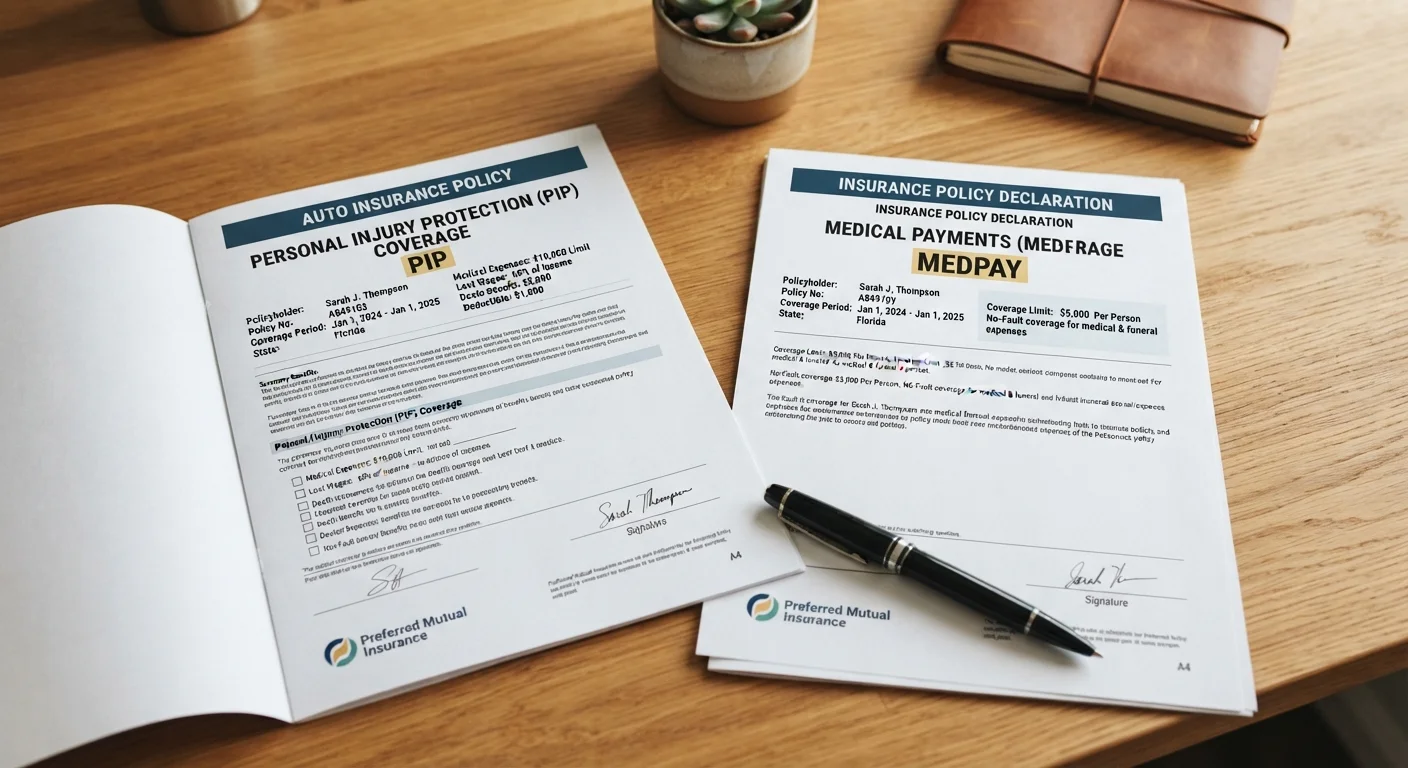
How each coverage fits into a full policy
Neither PIP nor MedPay is a substitute for liability coverage. Liability pays for injuries and property damage you cause to other people. PIP and MedPay address your own injuries and those of your passengers.
In no-fault states, drivers carry PIP and file claims with their own insurer first, no matter who caused the accident. This system is designed to speed up claims and reduce lawsuits over minor accidents. In fault-based (tort) states, the at-fault driver's liability coverage is the primary source of compensation for the other party, but MedPay can bridge the gap while a claim is being sorted out.
If you are comparing the broader picture of your policy, understanding the difference between state minimum and full coverage can help you see where PIP and MedPay fit in.
| Criterion | PIP | MedPay |
|---|---|---|
| Medical bills | Yes | Yes |
| Lost wages | Yes | No |
| Household services | Sometimes | No |
| Funeral expenses | Sometimes | Sometimes |
| Passengers covered | Yes | Yes |
| Fault requirement | None (no-fault) | None (no-fault) |
| State mandate | Required in no-fault states | Optional in most states |
| Deductible | Varies by state/insurer | Usually none |
Key differences that affect your decision
The most practical distinction is scope. PIP is designed as a more complete income-and-recovery safety net; MedPay is a medical bill buffer. If your employer provides generous sick leave and you have good health coverage, MedPay may cover what your health plan does not, such as copays and deductibles, without paying for broader PIP benefits you do not need.
Deductibles are another factor. MedPay typically carries no deductible, meaning the coverage applies from the first dollar of eligible expenses. PIP policies may include a deductible depending on the state and the insurer.
Coordination with health insurance also differs. Some PIP policies pay first and then your health insurer picks up any remainder. Others work the opposite way. MedPay coordination rules vary by insurer and state as well. Reading the actual policy language, or asking a licensed agent, is the only reliable way to know how your specific plan handles this.
State rules shape your options
For a broader view of how coverage layers interact, common coverage mistakes drivers make covers situations where gaps appear unexpectedly.
What to consider before adding either coverage
Start with your state. If you are in a no-fault state, PIP is likely required at a minimum level, so the question becomes whether to carry more than the minimum. If you are in a fault-based state, check whether MedPay is available and what limits your insurer offers.
Then look at your existing coverage. A health plan with low out-of-pocket maximums and disability income insurance may reduce the value of a high PIP limit. Someone without health insurance or with a high-deductible plan may find PIP or MedPay provides meaningful financial protection after an accident.
Limits for both coverages are generally modest, often ranging from $1,000 to $25,000 per person, though higher limits exist. Consider how collision and comprehensive coverage fit alongside these medical coverages when building out your full policy.
This article provides general information about auto insurance coverage types and is not personalized insurance, legal, or financial advice. Coverage availability, requirements, and terms vary by state and insurer. Consult a licensed insurance agent or adviser for guidance specific to your situation and policy.
The content provided on our blog site traverses numerous categories, offering readers valuable and practical information. Readers can use the editorial team’s research and data to gain more insights into their topics of interest. However, they are requested not to treat the articles as conclusive. The website team cannot be held responsible for differences in data or inaccuracies found across other platforms. Please also note that the site might also miss out on various schemes and offers available that the readers may find more beneficial than the ones we cover.