
What an Annual Percentage Rate Actually Tells You About a Loan


Photo: SmartGlobetrotter.net editorial
Key Takeaways
- APR includes the interest rate plus certain fees, making it a broader cost measure than the interest rate alone.
- A loan with a lower interest rate can still carry a higher APR if its fees are substantial.
- Federal law requires lenders to disclose APR, but the fees included can differ by loan type.
- APR is most useful when comparing loans with similar terms and repayment lengths.
- Consulting a licensed financial adviser helps you evaluate APR in the context of your full financial picture.
Why APR exists and what it measures
When a lender quotes you an interest rate, that number only captures one slice of what you will pay. Fees charged at origination, broker commissions, and certain closing costs add to your cost of borrowing but do not show up in the interest rate figure. APR was designed to fix that gap.
By folding a defined set of fees into the interest rate and expressing the combined total as a yearly percentage, APR lets you compare two loan offers on a common scale. A loan with a 6.5% interest rate and a $1,500 origination fee may cost more over its life than a loan with a 7% interest rate and no origination fee. The APR calculation makes that comparison possible without requiring you to do the math yourself.
Federal law under the Truth in Lending Act requires lenders to disclose APR before you sign. That disclosure appears in the loan estimate or the Loan Disclosure Statement, alongside the interest rate, so you can see both numbers together. For a plain-language explanation of the other terms you will encounter in those documents, see key terms in financial agreements explained.
What goes into an APR calculation
The core formula takes the periodic interest cost and adds any fees that are required to be included, then converts the total into an annualized rate. For a standard installment loan, required inclusions typically are:
- The stated interest rate applied to the loan balance
- Origination or underwriting fees charged by the lender
- Mortgage broker fees, where applicable
- Certain prepaid finance charges specified under TILA
What APR generally does not include: late payment fees, optional add-on products like credit insurance, and some third-party costs that are outside the lender's control. This means two loans with identical APRs can still differ in total cost if one carries heavier ancillary charges.
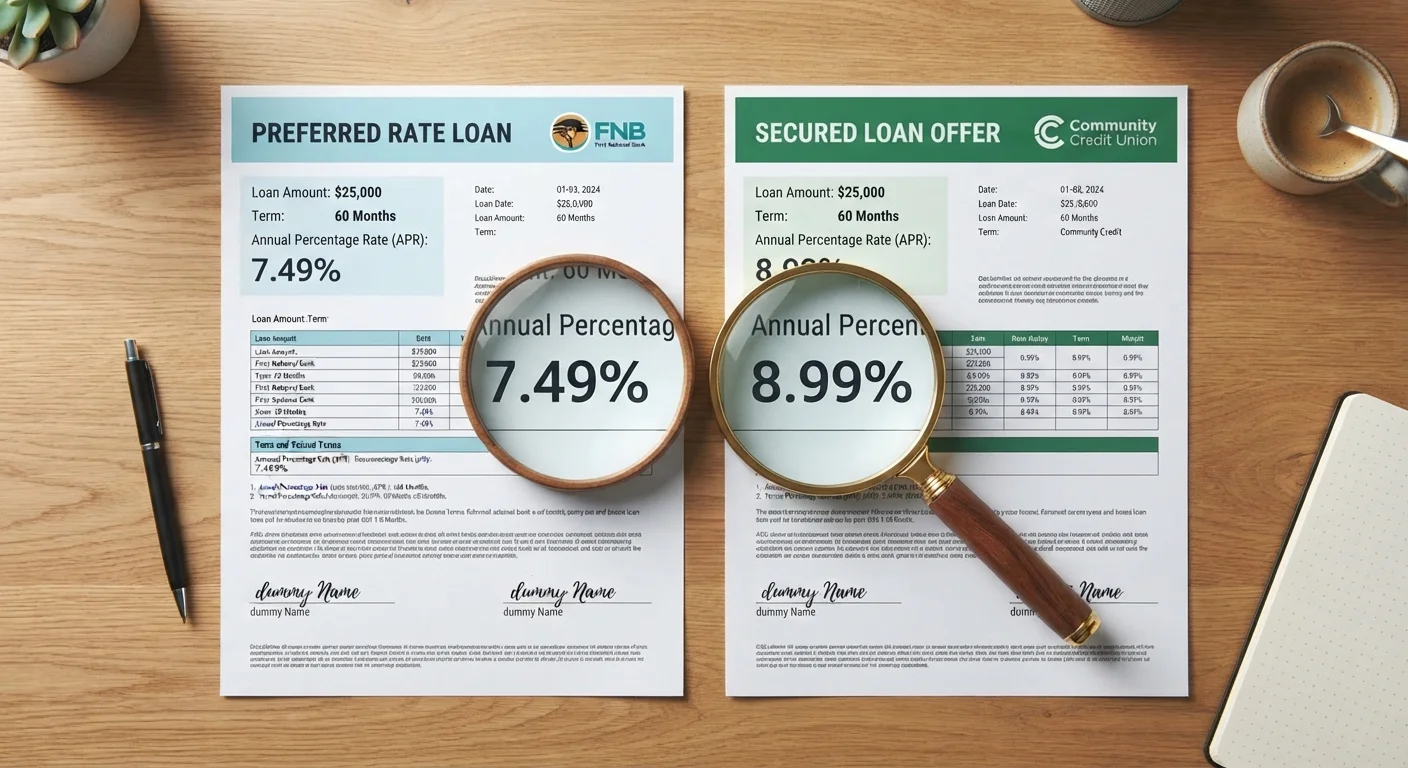
For mortgage loans, APR also incorporates discount points and private mortgage insurance premiums in some cases, which is why mortgage APR often sits noticeably above the stated interest rate. Auto loan APR tends to have a smaller gap because fewer fees are wrapped in.
~0.5% to 1.5%
Typical gap between mortgage interest rate and APR
The size of the gap depends on origination fees and points charged; Consumer Financial Protection Bureau guidance describes this range as common for conventional mortgages.
Required by law
APR disclosure before loan signing
The Truth in Lending Act (TILA) mandates that lenders provide APR disclosure before consummation of most consumer credit transactions.
How to use APR when comparing loans
APR is most reliable as a comparison tool when the loans you are evaluating have the same repayment length. A 5-year loan and a 10-year loan with the same APR are not equivalent because the longer loan gives fees more time to compound and changes your monthly payment significantly.
Steps that make APR comparisons more useful:
- Request the full fee disclosure alongside the APR, not just the headline number.
- Confirm the loan term is the same across the offers you are comparing.
- Ask whether the rate is fixed or variable. On variable loans, the APR shown is typically based on current index rates and will shift over time. The article on fixed vs. variable interest rates covers how those structures differ.
- Check for prepayment penalties, which will not appear in the APR but affect your total cost if you plan to pay off the loan early.
This article is for general informational purposes only and is not personalized financial or legal advice. Loan costs, terms, and fee structures vary by lender and loan type. Consult a licensed financial adviser or loan officer for guidance specific to your situation.
Frequently Asked Questions
The content provided on our blog site traverses numerous categories, offering readers valuable and practical information. Readers can use the editorial team’s research and data to gain more insights into their topics of interest. However, they are requested not to treat the articles as conclusive. The website team cannot be held responsible for differences in data or inaccuracies found across other platforms. Please also note that the site might also miss out on various schemes and offers available that the readers may find more beneficial than the ones we cover.