
Aging in Place vs. Moving to a Senior Community: Weighing the Trade-Offs

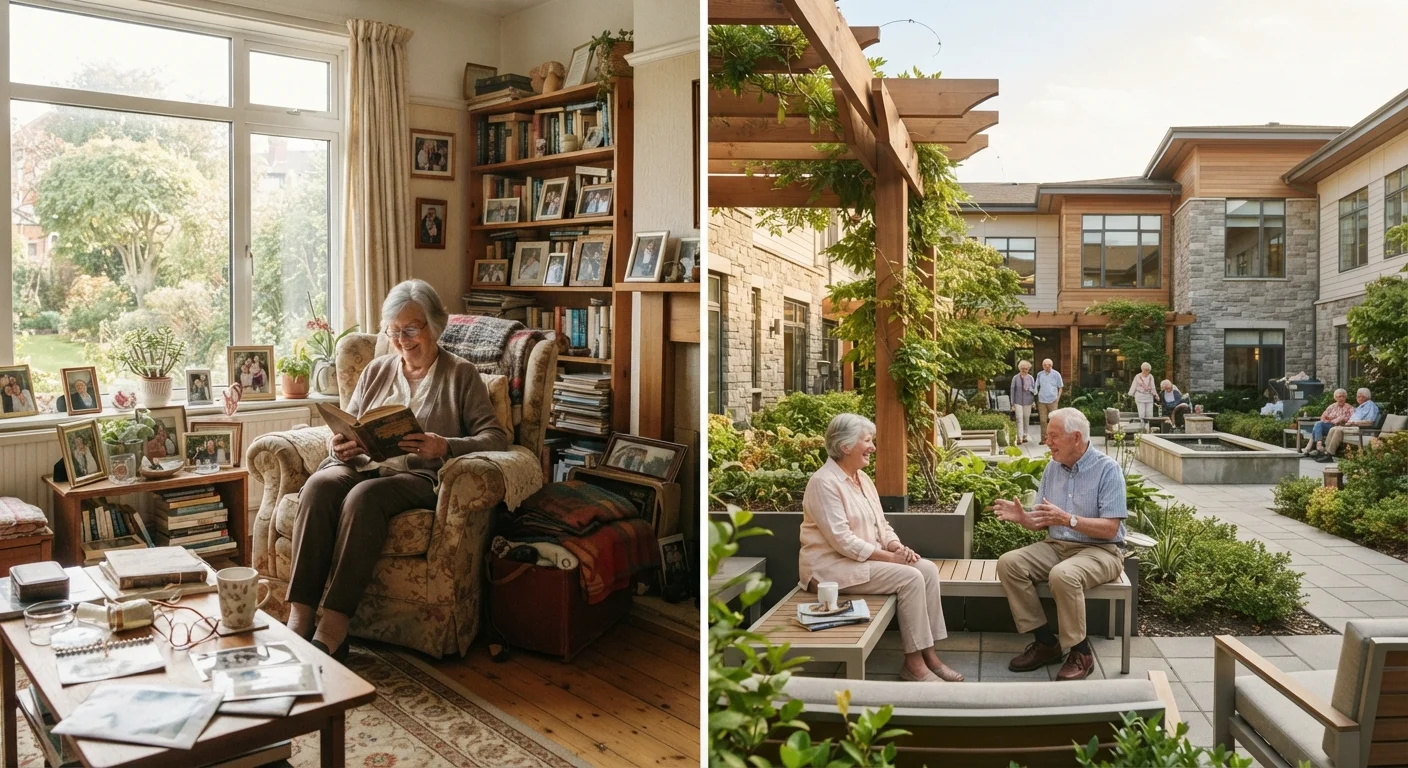
Photo: SmartGlobetrotter.net editorial
Key Takeaways
- Aging in place preserves independence and familiarity but can become costly and isolating as care needs grow.
- Senior communities provide built-in social connection and on-site care, but require giving up home ownership and privacy.
- Financial structure differs significantly: aging in place involves unpredictable home maintenance costs, while communities charge monthly fees that vary by care level.
- Family caregiving capacity and proximity are practical factors that often tip the decision one way or the other.
- Neither option is universally better; the right choice depends on health status, finances, social needs, and personal preferences.
Preserves independence and familiar surroundings
Remaining at home lets seniors maintain their daily routines, neighborhood relationships, and personal autonomy. Familiarity with a home's layout also has practical safety benefits for those with early memory concerns.
Often lower cost at early stages of aging
For seniors who are relatively healthy, staying home avoids monthly community fees that can range from roughly $2,500 to over $6,000 depending on care level and location. Home ownership may also preserve an asset that contributes to long-term financial security.
Flexible, customizable care options
In-home aides, adult day programs, and meal delivery services can be added or removed as needs change, giving families more control over the pace and scope of support.
Built-in social connection and programming
Senior communities reduce the social isolation that is a genuine health concern for many older adults living alone. Scheduled activities, communal dining, and on-site neighbors provide regular human contact without requiring transportation.
On-site access to care and emergency response
Assisted living and continuing care retirement communities (CCRCs) typically have staff available around the clock, which reduces risk during medical events and can relieve significant anxiety for family caregivers living far away.
Predictable monthly cost structure
A community's monthly fee, while often substantial, bundles housing, meals, utilities, and some care into one payment. This predictability can simplify budgeting for seniors on a fixed income.
Home modification costs can be significant
Grab bars, wheelchair ramps, stair lifts, and bathroom retrofits add up quickly, and some older homes require structural changes that run into tens of thousands of dollars. These costs are generally paid out of pocket.
Isolation risk grows over time
Driving limitations, the loss of peers, and reduced mobility can leave seniors at home with limited social contact. Social isolation carries well-documented health consequences, including increased risk of cognitive decline.
Family caregiver burden can become unsustainable
When professional care is not in place, the coordination and direct caregiving often falls on adult children or spouses. That burden affects caregiver health and relationships, and is not a stable long-term plan.
Monthly fees are substantial and rise with care needs
Moving into a community does not lock in costs permanently. As care needs increase from independent to assisted to memory care, monthly fees typically rise in step, and the total can exceed what many families anticipated.
Loss of home ownership and privacy
Selling the family home to fund community costs is a significant and often irreversible financial decision. Communal living also means adjusting to shared spaces, scheduled meals, and less control over daily environment.
Quality and culture vary widely by community
Senior communities differ considerably in staffing ratios, physical environment, programming, and care philosophy. Choosing poorly can mean significant disruption and another move down the line.
What the choice actually involves
The decision between aging in place and moving to a senior community is one of the most consequential housing choices an older adult or family can face. It touches finances, health, daily life, and family relationships all at once. There is no formula that produces the right answer, but there are specific factors that matter more than most people expect.
Aging in place means remaining in a private residence, typically the home a person has lived in for years, and bringing services in as needed. A senior community means relocating to a setting where housing, some level of care, and social programming are combined. Within that second category, options range from independent living to assisted living to memory care to continuing care retirement communities (CCRCs), which offer multiple levels on one campus.
The practical question is not which option sounds more appealing in the abstract. It is which one fits a specific person's health trajectory, financial picture, and support network. Having key legal documents in place before making this decision protects everyone involved and keeps choices available.
The case for aging in place
Staying home has genuine advantages that go beyond sentiment. Familiarity with a space, established neighborhood connections, and the ability to maintain personal routines all contribute to well-being in ways that are harder to replicate in a new environment.
Preserves independence and familiar surroundings
Remaining at home lets seniors maintain their daily routines, neighborhood relationships, and personal autonomy. Familiarity with a home's layout also has practical safety benefits for those with early memory concerns.
Often lower cost at early stages of aging
For seniors who are relatively healthy, staying home avoids monthly community fees that can range from roughly $2,500 to over $6,000 depending on care level and location. Home ownership may also preserve an asset that contributes to long-term financial security.
Flexible, customizable care options
In-home aides, adult day programs, and meal delivery services can be added or removed as needs change, giving families more control over the pace and scope of support.
Built-in social connection and programming
Senior communities reduce the social isolation that is a genuine health concern for many older adults living alone. Scheduled activities, communal dining, and on-site neighbors provide regular human contact without requiring transportation.
On-site access to care and emergency response
Assisted living and continuing care retirement communities (CCRCs) typically have staff available around the clock, which reduces risk during medical events and can relieve significant anxiety for family caregivers living far away.
Predictable monthly cost structure
A community's monthly fee, while often substantial, bundles housing, meals, utilities, and some care into one payment. This predictability can simplify budgeting for seniors on a fixed income.
The financial picture can favor aging in place at early stages of aging, particularly when health needs are modest and the home is already paid off or nearly so. However, costs tend to rise unevenly. A fall requiring home modifications, or the need for daily in-home aide hours, can shift the financial calculus faster than families anticipate. Anyone considering this path should build a realistic budget that includes home maintenance, potential modifications, and care costs. Strategies for managing money on a fixed income can help frame that planning.
The case for moving to a senior community
Senior communities address several problems that become harder to solve at home as health needs grow. Coordinating in-home care across multiple agencies, managing medication schedules, and handling home maintenance while managing chronic conditions is a real burden, and it does not fall only on the senior.

Home modification costs can be significant
Grab bars, wheelchair ramps, stair lifts, and bathroom retrofits add up quickly, and some older homes require structural changes that run into tens of thousands of dollars. These costs are generally paid out of pocket.
Isolation risk grows over time
Driving limitations, the loss of peers, and reduced mobility can leave seniors at home with limited social contact. Social isolation carries well-documented health consequences, including increased risk of cognitive decline.
Family caregiver burden can become unsustainable
When professional care is not in place, the coordination and direct caregiving often falls on adult children or spouses. That burden affects caregiver health and relationships, and is not a stable long-term plan.
Monthly fees are substantial and rise with care needs
Moving into a community does not lock in costs permanently. As care needs increase from independent to assisted to memory care, monthly fees typically rise in step, and the total can exceed what many families anticipated.
Loss of home ownership and privacy
Selling the family home to fund community costs is a significant and often irreversible financial decision. Communal living also means adjusting to shared spaces, scheduled meals, and less control over daily environment.
Quality and culture vary widely by community
Senior communities differ considerably in staffing ratios, physical environment, programming, and care philosophy. Choosing poorly can mean significant disruption and another move down the line.
For families navigating this transition, the logistics can be substantial. A family planning checklist for assisted living moves covers finances, care assessments, and legal steps in detail.
Medicare and Medicaid coverage differences
Financial structure: a closer comparison
Cost is rarely the only factor, but it shapes what is possible. Aging in place costs vary widely because they depend on the home's condition, the level of care needed, and local service rates. A senior needing 40 hours per week of professional in-home aide support in a high-cost metro area may pay more annually than a comparable assisted living placement.
77%
Older adults who prefer to age in place
According to AARP survey data, a large majority of adults age 50 and older want to remain in their homes as they age.
$54,000+
Median annual cost of assisted living
Genworth's Cost of Care Survey has consistently placed the median annual assisted living cost in the U.S. above $54,000, though figures vary substantially by state.
1 in 3
Adults 65+ living alone
U.S. Census Bureau data indicates that roughly one in three adults aged 65 and older lives alone, a factor directly relevant to safety and social connection.
Community costs depend on care level and geography. Independent living is generally less expensive than assisted living, which is less expensive than memory care. CCRCs often require a substantial entry fee in addition to monthly charges. Some of that entry fee may be partially refundable; the terms vary and should be reviewed carefully before signing.
Home equity is a resource some families use to fund either path, whether through a reverse mortgage, a sale that funds community placement, or drawing on savings. The financial trade-offs between renting and owning offers context on how home equity factors into longer-term housing decisions. For Social Security timing and how it interacts with monthly expenses, see our guide to Social Security benefits for older adults.
This article is for general informational purposes only and does not constitute financial, legal, or medical advice. Individual circumstances vary widely. Consult a licensed financial adviser, attorney, or qualified healthcare professional before making decisions based on your specific situation.
The content provided on our blog site traverses numerous categories, offering readers valuable and practical information. Readers can use the editorial team’s research and data to gain more insights into their topics of interest. However, they are requested not to treat the articles as conclusive. The website team cannot be held responsible for differences in data or inaccuracies found across other platforms. Please also note that the site might also miss out on various schemes and offers available that the readers may find more beneficial than the ones we cover.